
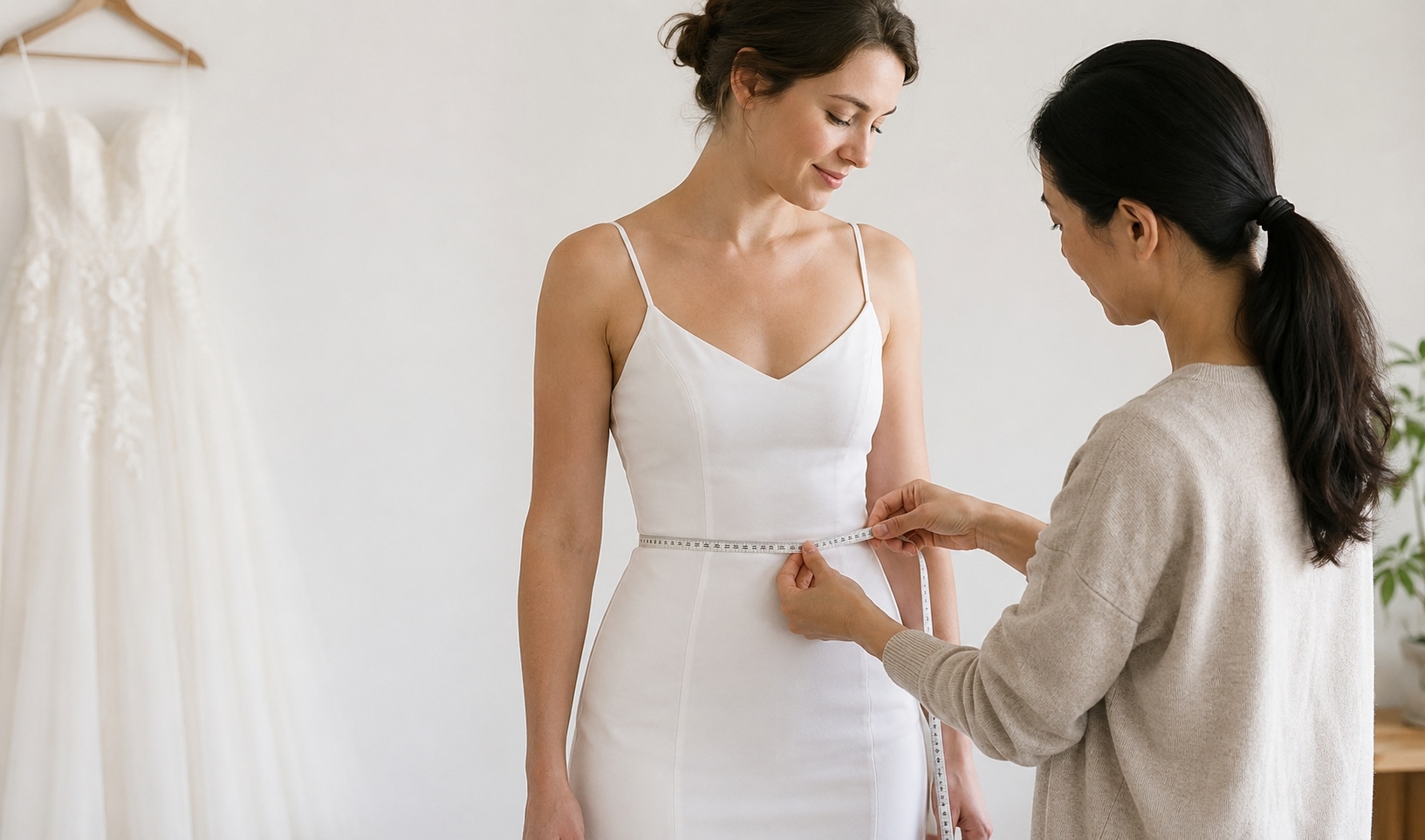
If you’ve ever tried on an off-the-rack wedding dress and found that the bust fits but the waist doesn’t—or the waist is perfect while the hips feel too tight—you’re not alone. Standard sizing simply can’t reflect every bride’s unique proportions.
That’s where a made-to-measure wedding dress can make a difference. And measuring yourself at home is easier than you might think. All you need is a soft measuring tape, the undergarments you plan to wear with your dress, and ideally, someone to help.
Before You Measure
Wear a non-padded bra or your planned bridal undergarments. Stand naturally with your feet together and breathe normally—don’t suck in your stomach or push out your chest.
Keep the measuring tape comfortably close to your body without pulling it tight. A helpful rule is to leave enough room to slip one finger between the tape and your body. Your wedding dress should follow your measurements without making normal breathing and movement uncomfortable.
Most importantly, ask someone to help you. Measuring yourself while bending, twisting, or looking down can easily change the numbers.
1. Bust
Wrap the tape around the fullest part of your bust, keeping it level across your back. Keep your arms relaxed at your sides while your helper takes the measurement.
Don’t measure your bra size instead. A 36C bra, for example, does not automatically mean your bust measurement is 36 inches.
2. Waist
Measure around your natural waist, usually the narrowest part of your torso and often about 1–2 inches above your belly button.
Not sure where it is? Bend gently to one side. The crease that forms is a useful guide to your natural waistline.
Avoid pulling the tape inward to create a smaller number. We need your real body measurement—not the measurement you hope to be by the wedding day.
3. Hips
Stand with your feet together and wrap the tape around the fullest part of your hips and seat. Depending on your proportions, this may be lower than you expect.
Check the tape from the side or in a mirror to make sure it stays parallel to the floor.
4. Hollow to Hem
This is one of the most important—and most frequently misunderstood—measurements for a custom wedding dress.
Start at the hollow, the small indentation at the center between your collarbones. Measure straight down the front of your body to where you want the hemline of your wedding dress to fall.
The key word here is hem. Hollow-to-hem is measured to the dress hemline, not automatically to the floor. If you plan to wear heels, take the intended shoe height and finished dress length into account when determining where the hem should fall.
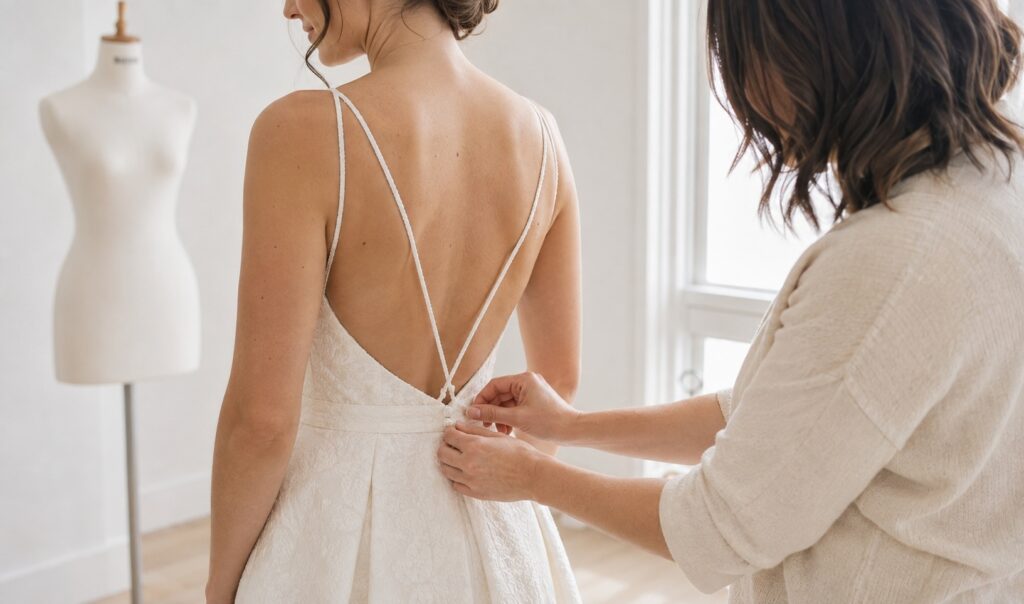
Two Quick Checks Before You Submit Your Measurements
Before sending your measurements to InWeddingDress, take a minute to see whether the numbers make sense together.
Bust and waist are almost identical?
This can happen, because every body is different. However, the waist is commonly smaller than the bust. If your bust and waist measurements are identical or unusually close, measure both again rather than assuming the first numbers are correct.
If they remain close, provide your under-bust measurement as well. Measure directly underneath the bust, keeping the tape level. This extra measurement can help our patternmakers better understand your proportions and check the measurements before production.
Height and hollow-to-hem look surprisingly close—or far apart?
Use this as a rough sanity check: for many adults, the difference between total height and a floor-length hollow-to-hem measurement is approximately 10 inches (25 cm), reflecting roughly the distance from the top of the head to the hollow.
It is not a universal body-proportion rule, especially when heel height or desired hem length changes. But if your numbers differ dramatically—for example, by 15 inches or more—it is worth measuring again. Check that you started at the hollow and that the tape traveled vertically rather than diagonally.
Still Worried You Measured Something Wrong? We Double-Check.
One of the biggest concerns brides have when ordering a made-to-measure wedding dress online is simple: What if I make a measuring mistake?
At InWeddingDress, your measurements aren’t treated as isolated numbers. Our experienced patternmakers review the measurements you submit and look at how they relate to one another.
If something appears unusual—such as measurements that seem inconsistent with the rest of your proportions—our team may contact you and ask you to measure again or provide an additional measurement before your dress goes into production.
Think of it as a second pair of expert eyes on your measuring tape.
Your body doesn’t need to fit neatly into a standard size number. A made-to-measure wedding dress starts with something much more useful: your actual proportions.
So grab a soft measuring tape, ask someone you trust for five minutes of help, measure twice, and send us the real numbers. We’ll help you take it from there.