
Looking at lace swatches on a bridal table is one thing. Seeing how that fabric transforms into a full-length wedding gown—and how it looks and moves once you’re wearing it—is entirely another.
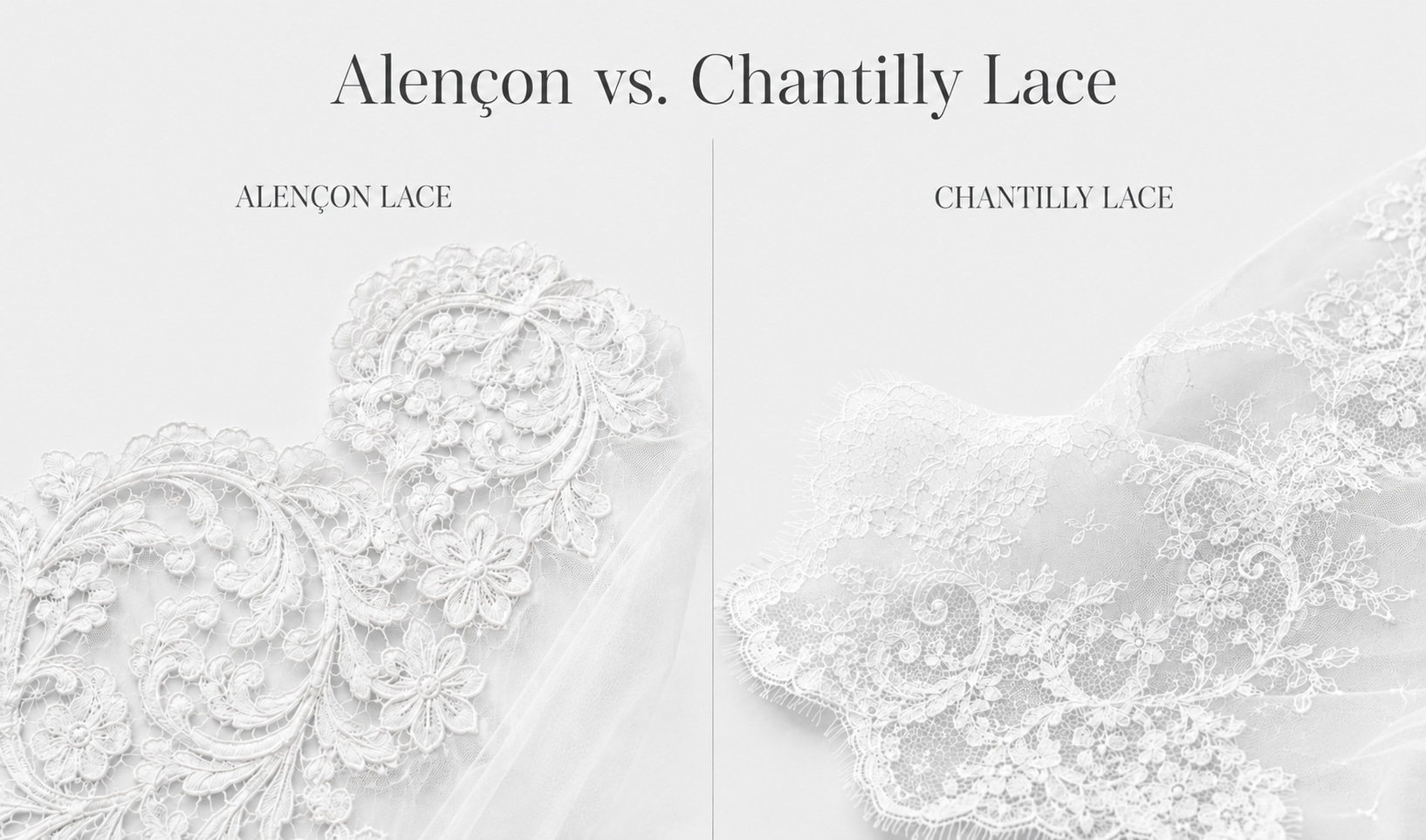
That’s especially true of Alençon and Chantilly, two French laces that may appear similar at first glance but create noticeably different effects on a wedding dress. The easiest way to think about the difference? Alençon gives a gown definition and dimension; Chantilly brings softness, transparency, and movement.
Here’s what that actually means when you’re shopping for your dress.
Alençon Lace: For Definition and Dimension
Alençon is the more substantial of the two. Its signature is the fine cording that traces the edges of its floral motifs, giving the lace a slightly raised, almost embroidered appearance. On a wedding gown, that extra dimension makes the pattern feel more pronounced rather than simply blending into the fabric beneath it.
That’s why Alençon works particularly well when lace is meant to be a focal point. Across a fitted bodice, for example, the motifs can emphasize the shape and construction of a corset; along a train or neckline, they create details that remain visible even from a distance.
The overall effect tends to feel polished and defined, but that doesn’t necessarily mean traditional. One of the most modern ways to wear Alençon is to use it selectively: think a dimensional lace bodice paired with a clean crepe or satin skirt, or individual motifs placed over sheer tulle. The contrast keeps the lace from feeling overly ornate while allowing its texture to stand out.
Consider Alençon if: You’re drawn to visible texture, sculpted bodices, statement trains, or a wedding dress with a little more visual structure.
Chantilly Lace: For Softness and Movement
If Alençon is about definition, Chantilly is about delicacy. Made with a fine net ground and intricate floral patterns, it is flatter, lighter, and more transparent, creating a softer effect against the body.
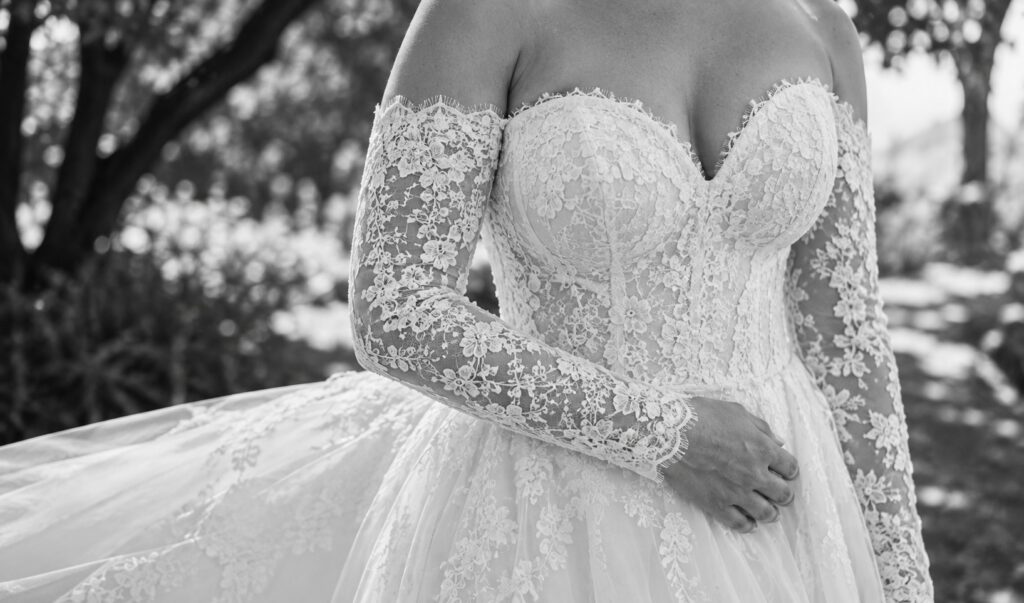
On sheer sleeves, necklines, and illusion panels, Chantilly can appear almost like the pattern is floating directly on the skin. Used across an entire skirt, it moves easily and adds detail without making the silhouette look heavier. This makes it a natural fit for wedding dresses that are meant to feel romantic and effortless rather than highly constructed.
Its delicacy also makes Chantilly particularly good at layering. Designers often place it beneath tulle, organza, or additional appliqués, so the lace is visible without immediately revealing where one texture ends and another begins. The result is less about one obvious lace motif and more about creating depth.
Consider Chantilly if: You love sheer details, soft movement, lightweight layers, or lace that feels subtle rather than sculptural.
What About Your Venue?
Your setting can help guide the decision—but it shouldn’t dictate it.
The dimensional quality of Alençon can hold its own beautifully in spaces with strong visual presence, from historic estates to formal ballrooms. Chantilly’s lighter quality, meanwhile, naturally complements garden ceremonies, destination weddings, and other settings where movement and ease are part of the look.
But the more useful question is not “Which lace matches my venue?” It’s “How do I want my lace wedding dress to feel within that space?” A sheer Chantilly gown can create an unexpected softness inside a grand cathedral, just as an Alençon bodice can add definition to an otherwise relaxed outdoor wedding look.
A More Modern Way to Wear Lace
The most compelling bridal looks don’t always treat Alençon and Chantilly as an either-or choice. Because the two laces do such different things, they can be even more effective when used together—or contrasted with fabrics that have no embellishment at all.
A designer might use Chantilly as a barely-there foundation across a sheer bodice, then layer more dimensional lace motifs over it to create depth without losing transparency. Alençon, meanwhile, can be concentrated at the neckline, waist, or train rather than covering the entire gown, allowing its texture to become an intentional focal point. Paired with smooth crepe, satin, or mikado, that contrast can make traditional lace feel surprisingly clean and contemporary.
That shift is what makes lace feel relevant in modern bridal fashion: it no longer has to be the dress—it can be the detail that shapes the dress. Chantilly can soften a sharply constructed silhouette; Alençon can bring dimension to an otherwise minimalist one. And when the two appear together, the contrast between something almost weightless and something distinctly tactile creates the kind of depth that a single lace rarely achieves on its own.
So the more interesting question isn’t necessarily Alençon or Chantilly? It’s where—and how much? A whisper of Chantilly at the neckline can change the mood of a minimalist gown; a few dimensional Alençon motifs can turn a simple train into the detail everyone notices as you walk down the aisle.