
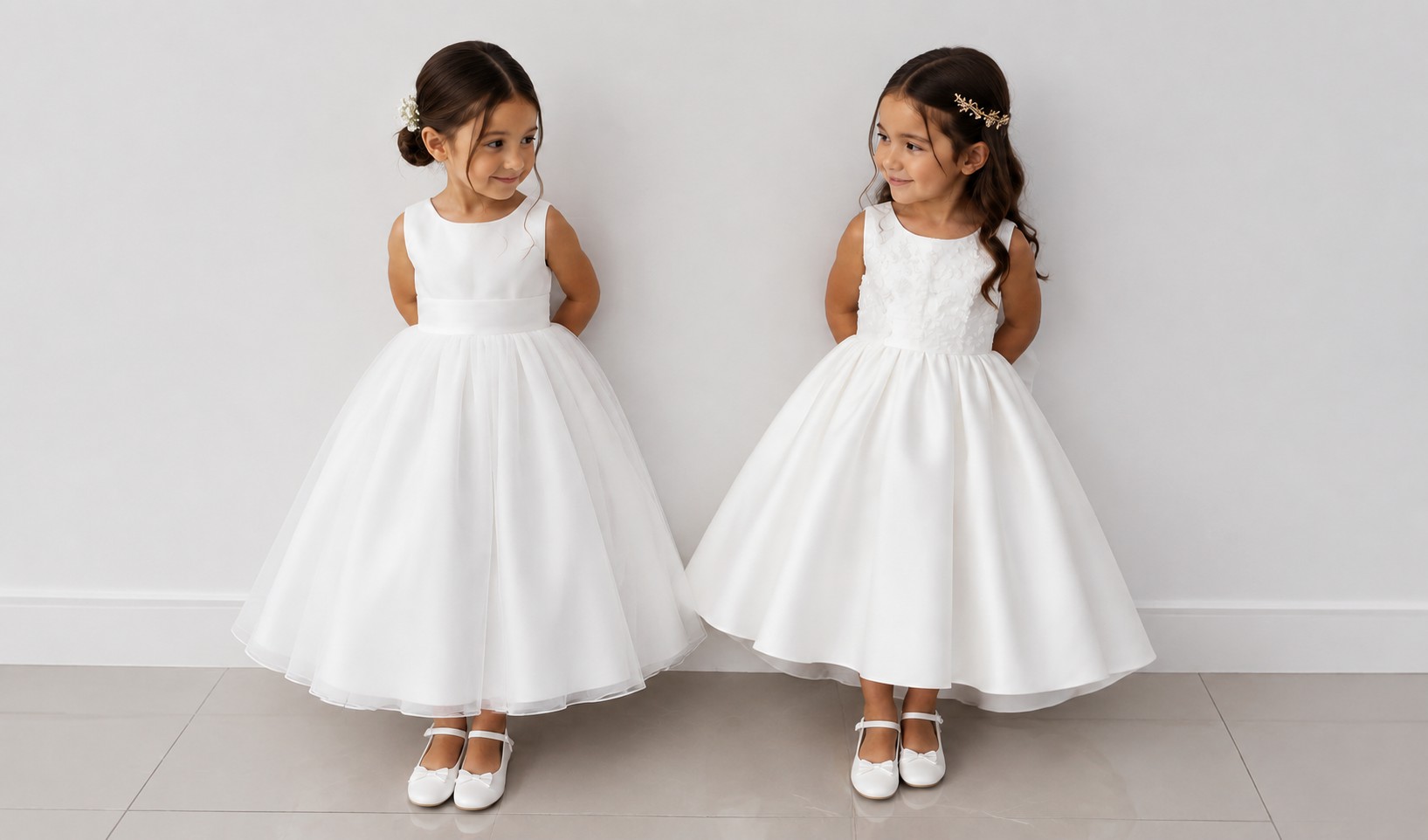
The easiest mistake to make with a flower girl dress for a formal wedding is not choosing something too casual. It’s choosing something too formal.
Lace, pearls, a satin sash, a full tulle skirt, and an elaborate headpiece may all feel appropriate on their own. Put them together, though, and the flower girl can quickly start to look like a miniature bride.
For a church ceremony, hotel ballroom, or formal evening reception, a better approach is to borrow just one or two elements from the bridal look. It might be the color of the gown, the fabric, a lace detail, or the shape of the skirt. That small connection is usually enough to make the flower girl look like part of the wedding without overwhelming her.
Start With the Wedding Dress
Before shopping for the flower girl, look at what the bride is wearing.
A clean satin wedding gown pairs naturally with a simple satin flower girl dress. If lace is a defining feature of the bridal gown, it can reappear more subtly on the flower girl’s bodice, sleeves, or neckline.
The same idea applies to silhouette. A traditional wedding gown with a fuller skirt can be echoed with a softly flared A-line dress or a light tulle skirt. If the bride’s gown is sleek and minimal, the flower girl’s dress can have a cleaner shape with fewer layers.
The goal is not to find a child-size version of the wedding gown. In fact, the strongest pairings rarely match exactly. They simply share enough detail to look intentional when the bride and flower girl are photographed together.
White or Ivory? Follow the Bride’s Undertone
A white flower girl dress sounds straightforward until it is placed next to an ivory wedding gown.
Pure white tends to look brighter and cooler, while ivory has a warmer, softer tone. If the bride is wearing ivory and the flower girl is in a crisp optical white, the contrast can make the bridal gown appear more yellow in photographs.
A useful rule is to stay within the same color family. Pair a pure-white bridal gown with white or cool soft white; pair ivory or cream with ivory, warm white, or a similarly soft neutral.
An exact color match is not necessary.
Satin reflects light, tulle is translucent, and lace creates shadows through its texture. Three fabrics labeled “ivory” can look slightly different once they are next to each other. Matching the overall undertone matters more than matching the shade perfectly.
If you also want to connect the flower girl to the bridesmaids, there is no need to change the entire dress color. A satin sash in the bridesmaid color can be enough to bring the bridal party together.
Satin or Lace? It Depends on the Kind of Formal
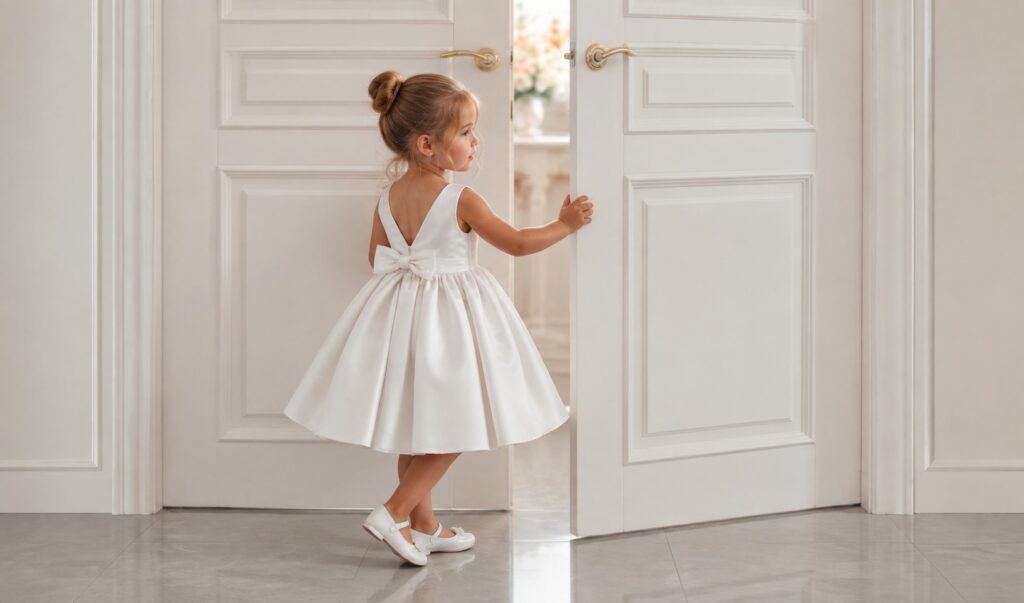
Satin brings structure and polish without requiring much decoration. That makes it particularly well suited to ballroom weddings and formal evening receptions. Even a simple satin A-line dress can feel appropriately formal with little more than a defined waist.
Lace has a softer, more traditional character. It works especially well for church ceremonies and weddings where the bride’s gown already features lace. A lace bodice, cap sleeve, or delicate trim can create the connection without covering the entire dress in embellishment.
And there is no reason the two cannot be combined.
A lace bodice with a satin sash and soft tulle skirt is a classic combination because each fabric has a job: lace adds detail, satin gives the waist definition, and tulle keeps the skirt light.
One detail worth checking has nothing to do with appearance: the inside of the lace.
Decorative lace that feels only slightly stiff to an adult can be irritating around a child’s neck, arms, or underarms. Look for soft lining anywhere lace, beading, or embroidery might otherwise sit directly against the skin.
For Younger Flower Girls, Tea-Length Is Often the Better Choice
A floor-length flower girl dress certainly looks formal, particularly in a grand ballroom or at an evening reception. But for younger flower girls, tea-length is often easier to wear and just as appropriate.
A skirt that ends around the calf keeps the feet clear, which matters when a child is walking down a long aisle, climbing church steps, or carrying a basket while scattering petals.
Older flower girls may be perfectly comfortable in floor-length dresses. Even then, the hem should ideally skim the shoes rather than pool around the feet.
There is a very simple way to test the length: stop evaluating the dress while the child is standing still.
Put on the shoes she will wear at the wedding and ask her to walk, turn, sit down, and climb a few steps. If she has to hold the skirt up every time she moves, it is too long—no matter how beautiful it looks in a fitting-room photo.
Formal Doesn’t Have to Mean More Embellishment
Pearls, bows, embroidery, lace, and layers of tulle can all work for a formal flower girl dress. They do not all need to appear on the same dress.
If the satin already has a beautiful sheen, the dress may not need beading. If the lace bodice provides plenty of detail, keep the skirt simple. If a colored sash is being used to coordinate with the bridesmaids, there may be no reason to introduce another accent color.
Formal dressing often looks better when something is left out.
That restraint also makes the dress easier for a child to wear. Heavy petticoats, stiff waistbands, scratchy sequins, and restrictive sleeves can become much more noticeable after an hour or two.
During a fitting, pay attention to what the flower girl does rather than only how the dress looks. If she starts pulling at the neckline, scratching her arms, or complaining about the waistband after ten minutes, the dress is unlikely to become more comfortable on the wedding day.
Her dress should belong in the wedding. It should also let her walk down the aisle, sit through the ceremony, and enjoy the reception without spending the day thinking about what she is wearing.