
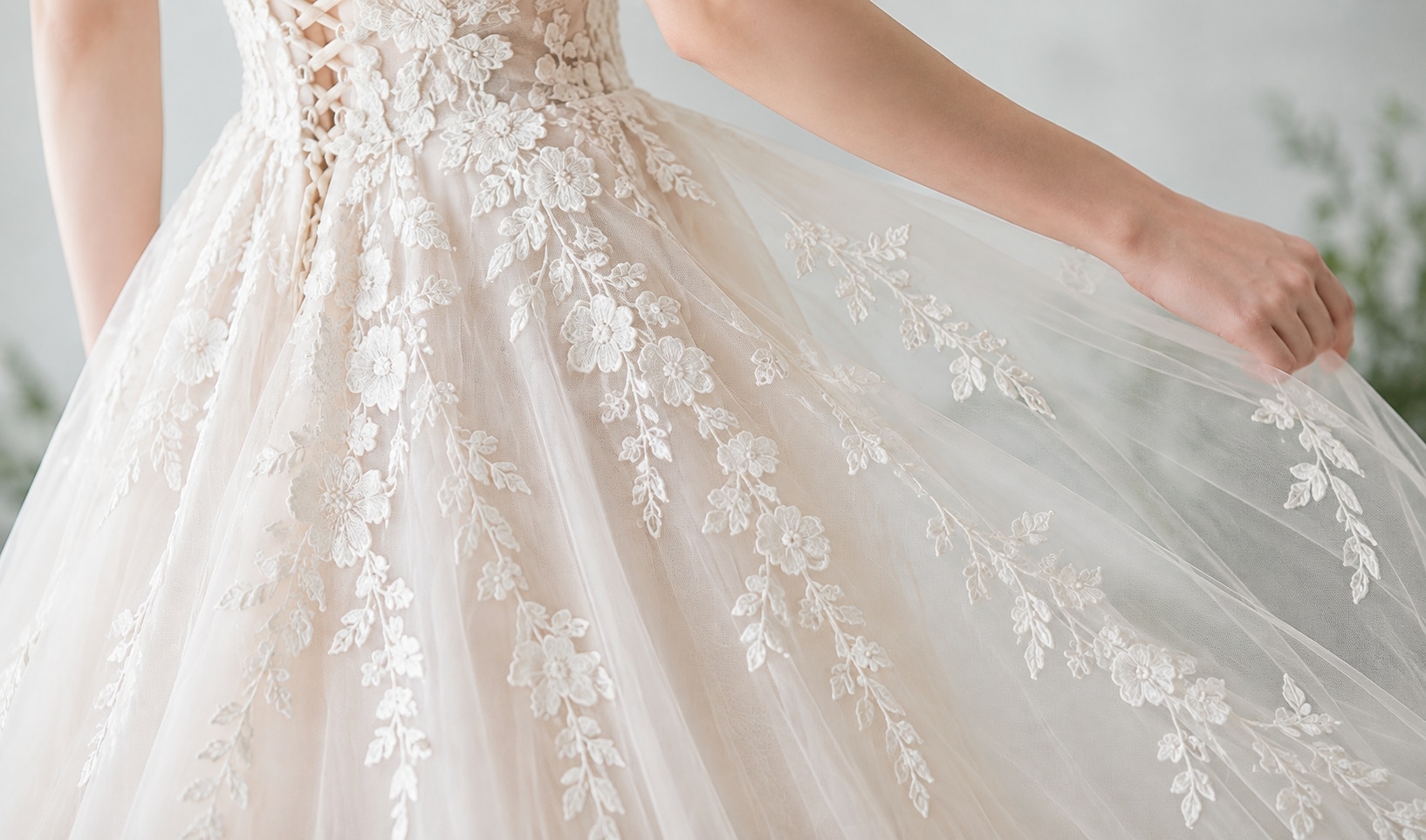
Lace remains one of bridal fashion’s most iconic signatures. It can feel whisper-light and barely there, or bold enough to anchor the structure of an entire gown. From formal cathedral ceremonies to relaxed garden and seaside weddings, the lace itself can give a wedding dress its distinctly romantic, traditional, or modern character.
But step into a bridal salon and you’ll hear terms like Chantilly, Alençon, Guipure, 3D lace, and lace appliqué—and they don’t all mean the same thing. Knowing the difference between a true lace type and a decorative technique can make it much easier to understand what you’re actually looking at on the rack.
Chantilly Lace: Delicate, Light, and Romantic
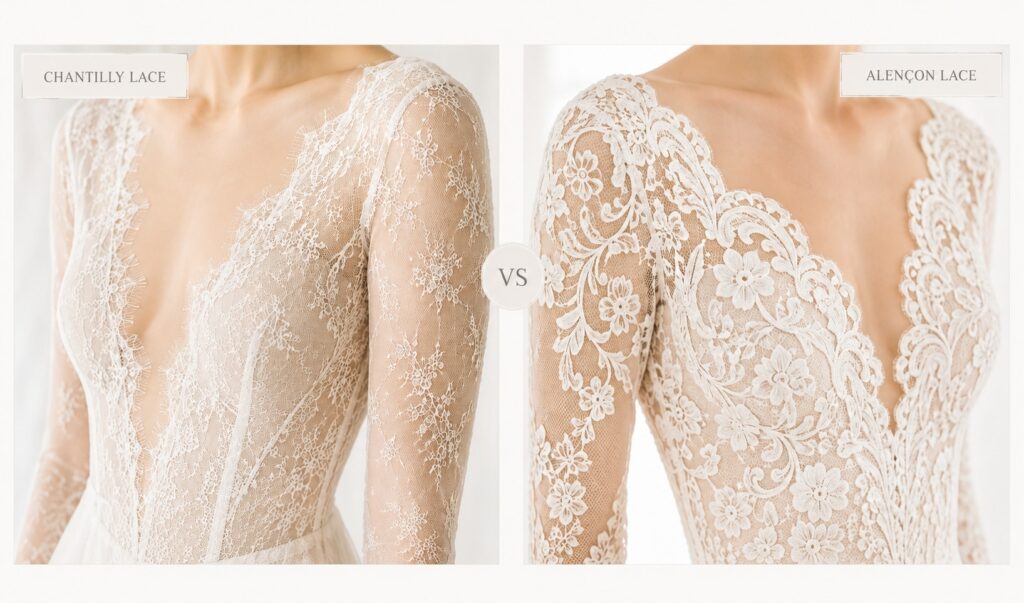
For brides drawn to softness and intricate detail, Chantilly lace is a bridal classic. Traditionally known for its fine net ground and delicate floral patterns, it has an exceptionally light, sheer appearance.
Because the motifs sit relatively flat against the net, Chantilly drapes closely over the body without adding much weight or bulk. That makes it particularly well suited to sheath and mermaid silhouettes, as well as illusion sleeves, high necklines, and gowns covered in a continuous layer of lace.
Look closely and much of its beauty lies in the fineness of the pattern rather than pronounced texture. The result feels romantic and refined, particularly on vintage-inspired gowns or designs where the lace is meant to soften the silhouette rather than dominate it.
Alençon Lace: Classic With a Sculpted Presence
If Chantilly is about ethereal softness, Alençon lace lends a more sculpted presence. Its floral motifs are traditionally worked over a net ground with more pronounced outlines, giving the pattern greater relief and visual weight.
That definition makes Alençon particularly striking on classic A-line gowns, formal wedding dresses, and silhouettes with an old-world sensibility. The pattern remains legible from a distance, while its finer details become more apparent up close.
For a bride who wants richness without relying on heavy embellishment, Alençon can provide much of that impact through texture alone.
Guipure and Venise Lace: Bold, Textural, and Structured
For a more graphic approach to lace, consider Guipure and Venise lace. Unlike Chantilly and Alençon, these styles don’t have the same fine, visible net ground. Instead, the motifs are connected to one another by bars or bridges.
This construction creates a denser fabric with clearly defined patterns and considerably more body. Depending on the scale of the motif, the effect can range from relaxed and bohemian to crisp and architectural.
Guipure and Venise are especially effective on clean-lined gowns, where a larger pattern can become the focal point without the need for sparkle. They can also work beautifully for outdoor and destination weddings, particularly when paired with simpler silhouettes that allow the texture to stand on its own.
Embroidered Tulle: The Modern Lace Look
Many fabrics described simply as “lace” in contemporary bridal collections are actually embroidered tulle. The distinction comes down to construction: The tulle or net exists first, and floral, botanical, or other motifs are then embroidered onto its surface.
That gives designers considerable freedom with the scale, density, and placement of a pattern. Embroidery can lie almost completely flat or incorporate layered petals and raised floral elements to create the popular 3D floral effect.
This is also why “3D lace,” while widely used as a bridal-fashion term, isn’t quite a lace type in the same sense as Chantilly or Guipure. In many gowns, what you’re seeing is dimensional embroidery worked over a tulle base.
The technique is particularly effective on ball gowns and romantic garden-inspired designs, where embroidered flowers can appear to float across multiple sheer layers.
Lace Appliqué: A Technique, Not a Type of Lace
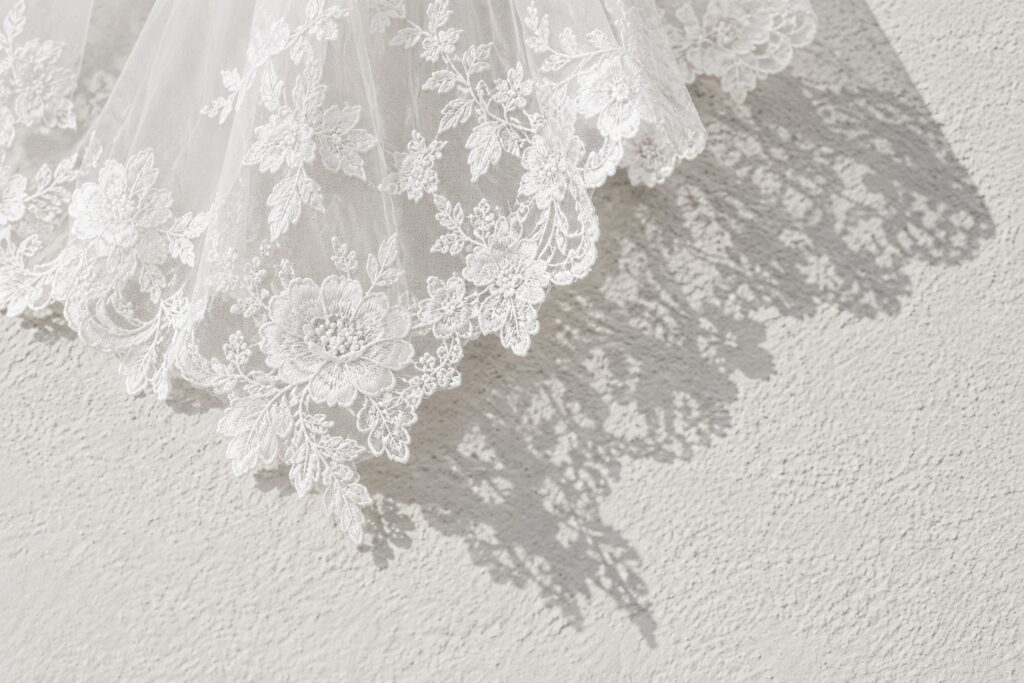
Another term worth understanding is lace appliqué. Despite the name, appliqué doesn’t refer to a specific lace construction. It describes the way lace—or individual embroidered motifs—is placed onto a gown.
Motifs are cut out and strategically sewn onto another fabric, often tulle, organza, or the base layer of the dress. This allows a designer to control exactly where each flower, leaf, or section of pattern falls.
On a bodice, motifs can be placed over sheer tulle to create an illusion effect, appearing to sit directly against the skin. They can also begin densely at the waist and gradually disperse down the skirt for a cascading effect, or be positioned individually along sleeves, necklines, and trains.
So, when a gown is described as having “lace appliqué,” read it as a clue to how the lace has been used, rather than what kind of lace it is.
Finding Your Match
When shopping, try not to judge lace from a swatch alone. A substantial Guipure that feels heavy in your hand can look remarkably clean and modern once it’s cut into a streamlined silhouette. Conversely, a delicate Chantilly that seems almost too subtle on the hanger can transform a gown when it extends across full-length illusion sleeves.
During your fittings, pay attention to more than the pattern. Feel the fabric against your skin, notice its weight, look at the scale of the motifs against your frame, and walk around to see how it moves. The right lace shouldn’t simply suit the venue or photograph beautifully—it should make the dress feel unmistakably like you.